

Rift Plate 018 · Everglades Maze
Mangrove Shadecat
A panther-shaped predator watches through water and builds its body from roots, reflection, and shadow.
- Plate group
- Everglades Maze
- Classification
- Riftborn Predator
- Field account
- Recovered
Recovered natural history
What witnesses saw.
The field account preserves what witnesses understood before the encounter became doctrine. It is observation, not certainty.
Field account
The lantern showed a panther drinking where no bank existed. Only the reflection had shoulders, whiskers, and yellow eyes. Then mangrove roots knitted themselves around a body of wet shadow, and a second reflected animal began circling behind the travelers. Two reflections can hunt, but only one root cage becomes flesh.
Observed behavior
A Shadecat watches through water before assembling a body. It targets whoever carries the map or light, places a visible decoy along one route, and builds the physical pounce inside whichever roots remain unwatched. Continually disturbed water makes it abandon the attack and reset.
Read the environment
The warning arrives before the creature.
A cat's reflection drinks beneath empty air.
Fresh claw scores appear below rather than above the waterline.
Route markers have been collected inside a mangrove-root hollow.
Survival doctrine
Recognize the rule. Break the advantage.
These are field principles, not promises. The Rift punishes anyone who mistakes one successful answer for a permanent law.
01
Mark the real body
Bright, sticky pollen clings to the shadow membrane and reveals which reflection can become physical.
02
Leave the roots
In open sawgrass or deep water without mangrove structure, the Shadecat can assemble little more than claws and eyes.
Recovered Field Plate
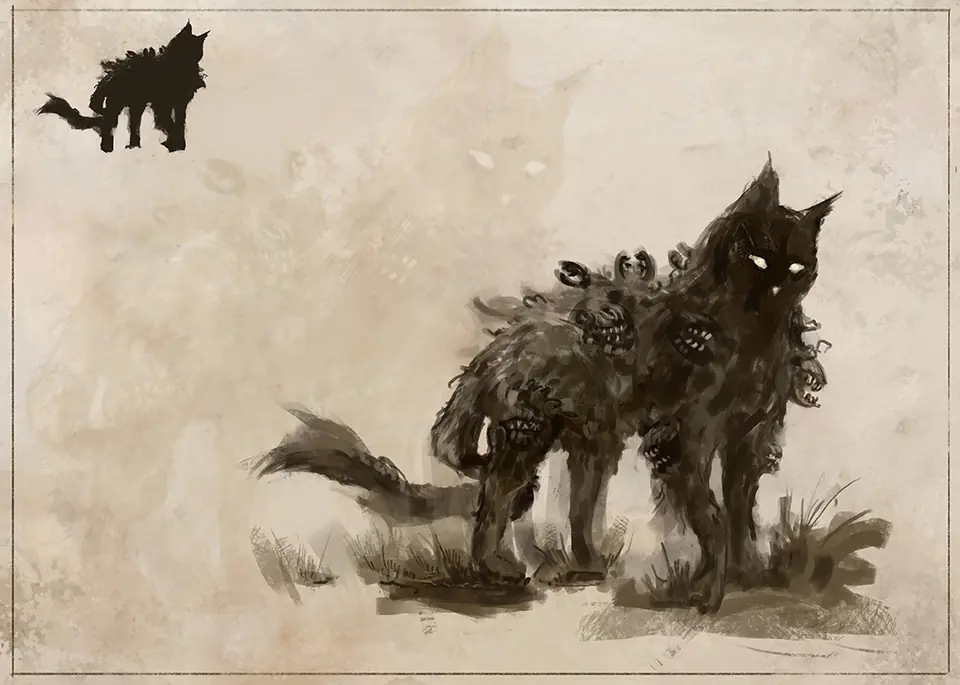
The sketch records its form. The surviving account records what it did.
01
Primary form
A large cat stands high on heavy paws while roots, knots, or fungal growths travel along its back.
02
Detail studies
The dark face and bright eyes remain readable beneath the growth that disrupts the animal outline.
Continue through the folio
018 of 100 recovered plates