

For Authors · Book and framework
Coming SoonAuthor as System
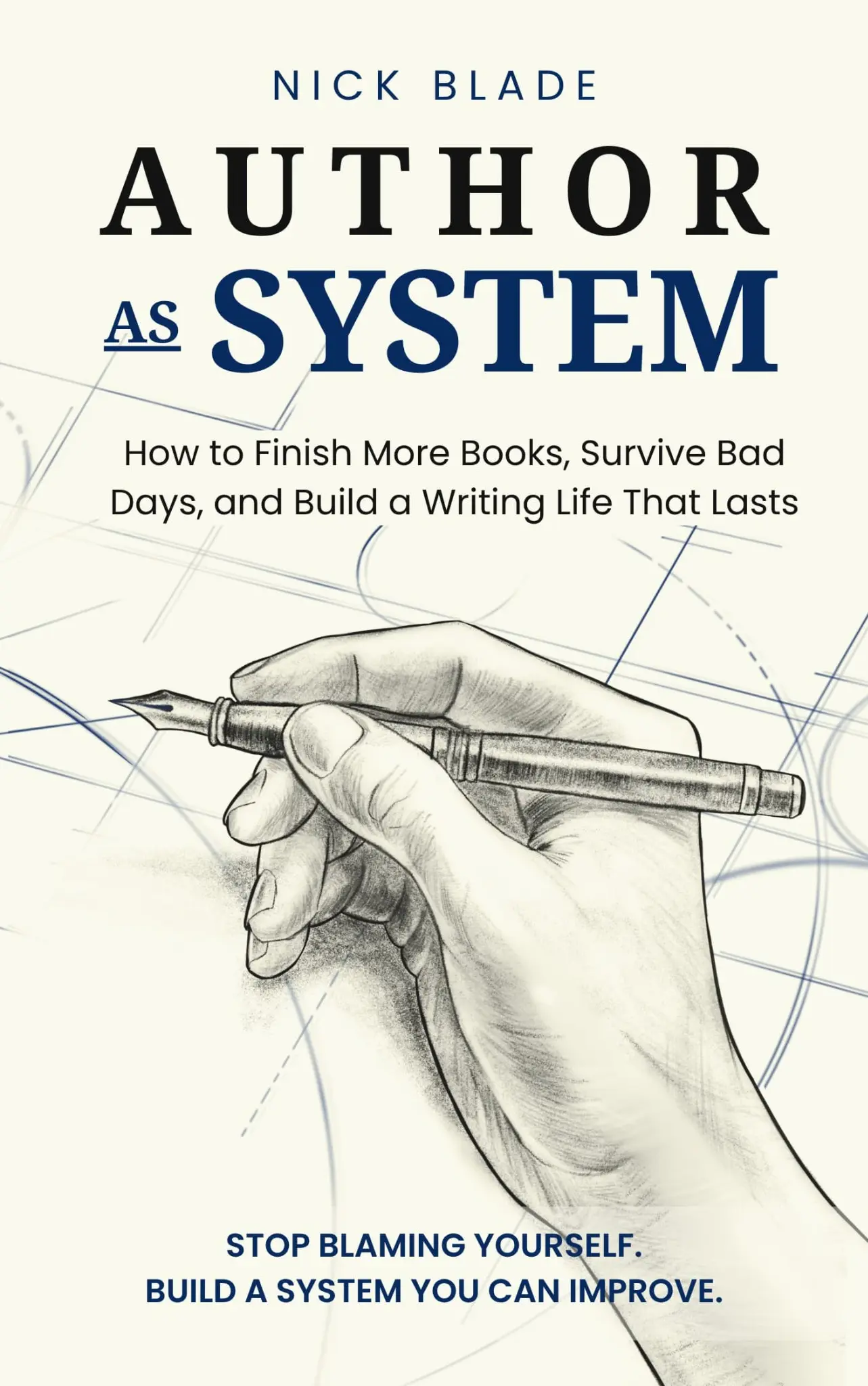
How to Finish More Books, Survive Bad Days, and Build a Writing Life That Lasts
Stop treating every difficult draft, broken week, or quiet launch as proof that you are the problem. Use clear working roles, project stages, input boundaries, bad-day operating levels, and restart methods to make the work visible enough to finish, protect, and improve.
The operating problem
The author is a person. The work still needs a system.
Creative work becomes brittle when identity, drafting, editing, publishing, feedback, and market response are allowed to speak at once. Every problem begins to sound personal. Every bad day begins to feel permanent.
Author as System separates those forces so the right problem can reach the right part of the process. The goal is not to turn the author into a machine. It is to build a creative life strong enough to carry a human being.
For the shorter definition, read What Is an Author Operating System?
How the book helps
Leave with a writing practice you can diagnose and repair.
This is not a collection of encouragements. It gives authors a practical way to see where the work is failing, choose the right intervention, and make the next return cheaper.
01
Diagnose the real problem
Separate Self, Work, and Market so a tired author, a structural weakness, and a quiet launch stop receiving the same response.
02
Make each session easier to enter
Name the active role, the project stage, and the next visible outcome instead of asking one hour to solve drafting, editing, publishing, and career strategy at once.
03
Keep outside noise from running the book
Give feedback, metrics, comparison, market research, and advice a time and a job before they are allowed to influence vulnerable creative work.
04
Build for bad days and real interruptions
Create a Floor, Standard, and Stretch; define reduced and recovery modes; and leave enough external memory to return without reconstructing the whole project.
05
Finish at the right standard
Move from Raw to Whole to Strong to Publishable with clear pass criteria, so early work can remain unfinished in the right way and revision can eventually end.
06
Let one book strengthen the next
Turn finished work into reader trust, owned connections, reusable assets, better decisions, and a body of work that does not return to zero after every release.
Inside the book
Twelve chapters that move from self-protection to a body of work.
The sequence matters. It first removes identity from the diagnosis, then makes the work operable, protects it from badly timed input, teaches it to survive variance, and finally lets one book strengthen the next.
Part I
Part I: Separate
Chapter 1 · The Wrong Question
Take your worth out of the manuscript. Learn to route problems to Self, Work, or Market before choosing a repair.
Part II
Part II: Operate
Chapters 2-3 · The Right Job · See the Whole System
Separate the five jobs hidden inside “write,” map the path from Capture to Reuse, and find the earliest bottleneck instead of calling the whole project stuck.
Part III
Part III: Protect
Chapters 4-5 · Protect the Creative Core · Make Feedback Earn Authority
Control when outside information speaks. Compile feedback into noise, patterns, and author-owned revision instructions.
Part IV
Part IV: Survive
Chapters 6-10 · Decisions · Capacity · Quality · Failure · Re-entry
Make defensible decisions without certainty, design a week that survives Tuesday, define done, learn from failure, and make interrupted projects inexpensive to restart.
Part V
Part V: Compound
Chapters 11-12 · Own the Reader Relationship · Build What Compounds
Use platforms without depending on them for everything, build bridges to readers, and let books create durable assets and direction for the work that follows.
The framework
Five movements. One repairable practice.
Each movement solves a different failure mode. Together they make the work visible enough to operate without confusing output with worth.
Author system · operating sequence
- 01Separate
- 02Operate
- 03Protect
- 04Survive
- 05Compound
The sequence is a way to see the work—not a promise that creative life becomes linear.
- 01
Put each problem in the right room.
Separate
Distinguish Self, Work, and Market so a difficult page, a weak launch, or public silence does not get mistaken for a verdict on the person doing the work.
Is this problem about me, the work itself, or the market around it?
- 02
Give one role authority at a time.
Operate
Separate Architect, Drafter, Editor, Publisher, and Steward so each working session has a real outcome—and one role is not allowed to sabotage another.
Which role owns this session, and what would make it complete?
- 03
Decide what reaches the work.
Protect
Use source, timing, and function to judge inputs before feedback, advice, metrics, or comparison cross the boundary into a vulnerable creative stage.
Is this useful signal for the work I am actually doing now?
- 04
Design for the bad day before it arrives.
Survive
Use decision classes, different clocks, flexible capacity levels, failure location, and deliberate return paths so one broken session does not become a broken identity.
What is the smallest honest version of continuity today?
- 05
Let one book strengthen the next.
Compound
Build ethical reader relationships, reusable creative assets, and body-of-work learning so effort can accumulate without turning the author into a content machine.
What can this work teach, preserve, or make easier next time?
Working tools
The book turns its ideas into things you can actually use.
Every major idea becomes a card, map, policy, review, or one-page record that can live beside a real project. The appendices gather them into an installation plan and quick-reference system.
- 01
Author System Canvas
A one-page operating manual for the project, capacity, boundaries, reader pathways, and next system repair.
- 02
Self / Work / Market incident report
A three-line diagnostic that stops one difficult event from becoming one global judgment.
- 03
Session Role Card
Role, outcome, what is not today’s problem, first visible action, and the note that makes tomorrow easier.
- 04
Project Status Page
A trusted record of the promise, stage, last move, next move, open decisions, current risk, and questions that remain closed.
- 05
Input and feedback controls
A practical input policy, metric windows, a feedback cooling period, and a compiler that turns reader response into usable revision work.
- 06
Decision Record
A way to classify reversible, costly, and committing choices; separate Daily, Project, and Career clocks; and close questions long enough to move.
- 07
Floor / Standard / Stretch
Three honest operating levels, plus reduced-mode and recovery rules for weeks that do not resemble the plan.
- 08
Done Card and revision passes
Stage-specific quality criteria and an order of passes that keeps sentence polish from hiding structural work.
- 09
Continuity Packet and restart cards
Handoff notes, anchor passages, warm/cool/cold return paths, and a salvage review for projects whose future is genuinely uncertain.
- 10
After-Action Review and Error Library
A seven-question review that separates impact from identity and makes each failure leave one portable process change.
- 11
Reader Dependency Audit and Asset Tree
Maps for owned, rented, and shared reader relationships—and for choosing what a finished book should create next.
- 12
Thirty-day installation plan
A day-by-day way to install the system without attempting to become a different author all at once, followed by a ten-minute monthly reset.
Self
Work
Market
The connective idea
A canvas, not a scorecard.
The Author System Canvas brings the five movements into one view: the roles you play, the boundaries that protect the work, the capacity you actually have, and what each book can teach the next.
It is designed to help you find the part of the work that is struggling without turning every difficult season into a verdict on your talent or your future.
Who this book is for
If caring more has not made the process easier, start here.
Author as System is for fiction and nonfiction authors at any stage who do not need another lecture about wanting the work badly enough. They need a structure that can carry that devotion through an ordinary human life.
- You care deeply about writing, but unfinished drafts or repeated stalls keep becoming evidence against you.
- Drafting, editing, publishing, platform work, and long-range decisions are competing for the same attention.
- A bad week makes the project go cold, and returning costs almost as much as beginning again.
- Feedback, sales, reviews, comparison, or market advice reach the work before they can actually help it.
- You want to finish books without building a creative life that depends on perfect conditions, constant output, or constant proof.
- You want each release to strengthen your reader relationships, process, assets, and future body of work.
Built for real creative lives
What this framework will never ask you to become
This is a framework for creative process and decision design—not a craft formula, productivity contest, publishing shortcut, or promise that every difficult season can be optimized away.
- Not a universal daily-word-count system
- Not a plot, prose, or genre formula
- Not a launch hack or passive-income promise
- Not a substitute for editorial, medical, or mental-health expertise
Common questions
What kind of help this book offers—and what it does not promise.
Is Author as System a writing-craft book?
It supports craft without prescribing plots, prose, genres, or a universal creative method. Its subject is the operating system around the craft: roles, stages, decisions, boundaries, capacity, recovery, publishing, and continuity.
Is it only for full-time or already-published authors?
No. The framework is designed around the life and capacity an author actually has. Its examples include fiction and nonfiction, day jobs, caregiving, launches, long interruptions, unfinished drafts, and established catalogs.
Will it help me finish a stalled book?
It will help you locate why the book is stalled, choose the correct role and next test, define what done means for the current stage, and reduce the cost of returning. It does not promise that every project should be finished; it also provides a clean way to pause, salvage, reshape, or kill one.
Does the book cover publishing and audience building?
Yes, as part of the same system. It covers packaging and release work, metrics and launch conditions, reader permission and trust, platform dependency, owned and shared reader pathways, advocacy, reusable assets, and the long-term body of work—not launch hacks or guaranteed sales.
What can I use immediately?
The appendices include the one-page Author System Canvas, a completed example, a thirty-day installation plan, quick-reference cards, a ten-minute monthly reset, and a discussion guide for authors and writing groups.
Built from the same practice
Nick Blade writes the stories—and studies what lets them survive.
The fantasy and the framework are not separate personas. One is the work. The other is an attempt to understand the conditions that let the work continue.
About Nick Blade →Read the first book →