

Rift Plate 042 · River Veins
Miremaw Gator
A mud-armored gator uses levee banks as cover and ammunition, rising beneath boats with half the river on its back.
- Plate group
- River Veins
- Classification
- Bestial
- Field account
- Recovered
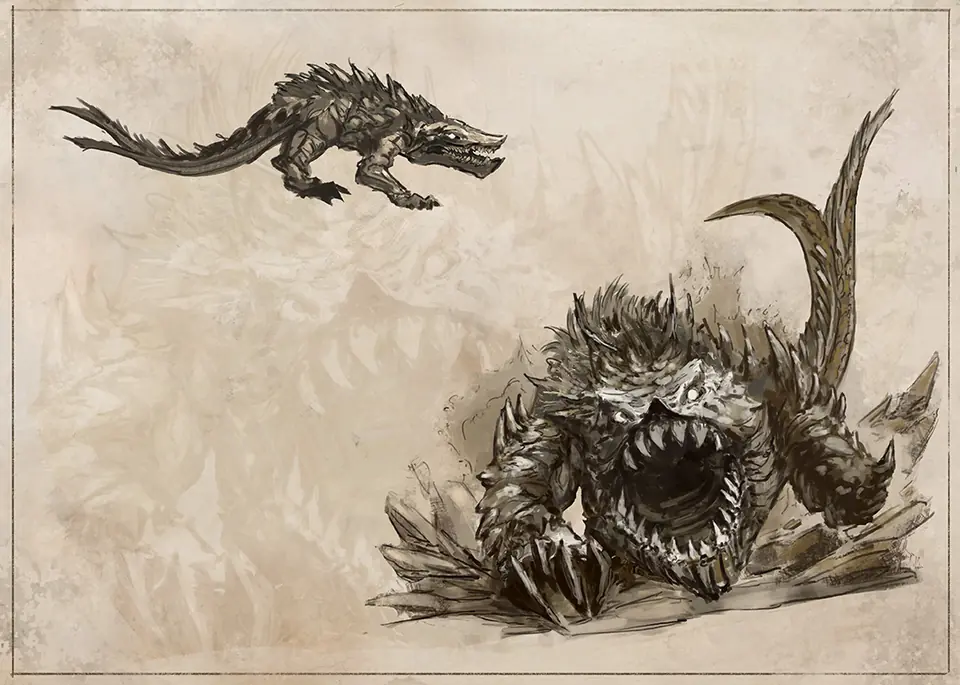
Recovered natural history
Field record
False-bank strike
An eye opened under the hymn scrap pasted to the bank. Then the bank hit our skiff sideways.
Levee stones had settled into the gator's back with driftwood and old rope. A rusted hook stuck out of one mud ridge. The body was wider than our skiff. The armored snout lifted the hull, and the animal rolled under the falling cargo. It hadn't needed to bite. Mud churned until we couldn't separate footing from water or animal.
Wounded, it sank into a levee cut. It came back with fresh clay packed over its scales.
Mud armor
It waits in the bank or under still water, then strikes with the shoulder. Boats and levee workers are targets; so are animals at the edge. A crushing tail sweep follows, and the churned mud repairs damaged plates. It relies on mass more than prolonged biting.
Dry land makes it slow to turn. In water the pivot is violent. Safely snagging an embedded rope or hook may turn the head, and the debris can give away its outline. Deep vibration draws it out. High light and open gravel discourage it.
Read the environment
Signs of its presence
An eye blinks below old hymn paper on a levee bank.
Rope loops or rusted hooks travel upstream without a current.
A broad mud wake grows in a still oxbow, carrying reeds.
Survival doctrine
Field precautions
01
Pale Jaw Seam
The hinge of the mouth can't carry mud armor. Place a pole or attack there to force the jaws open and turn the head.
02
Dry-Gravel Drag
Draw it onto high gravel. The embedded debris catches and the mud armor crumbles off the ordinary scales beneath.
Continue through the folio
042 of 100 recovered plates