

Rift Plate 079 · Gate of Stone
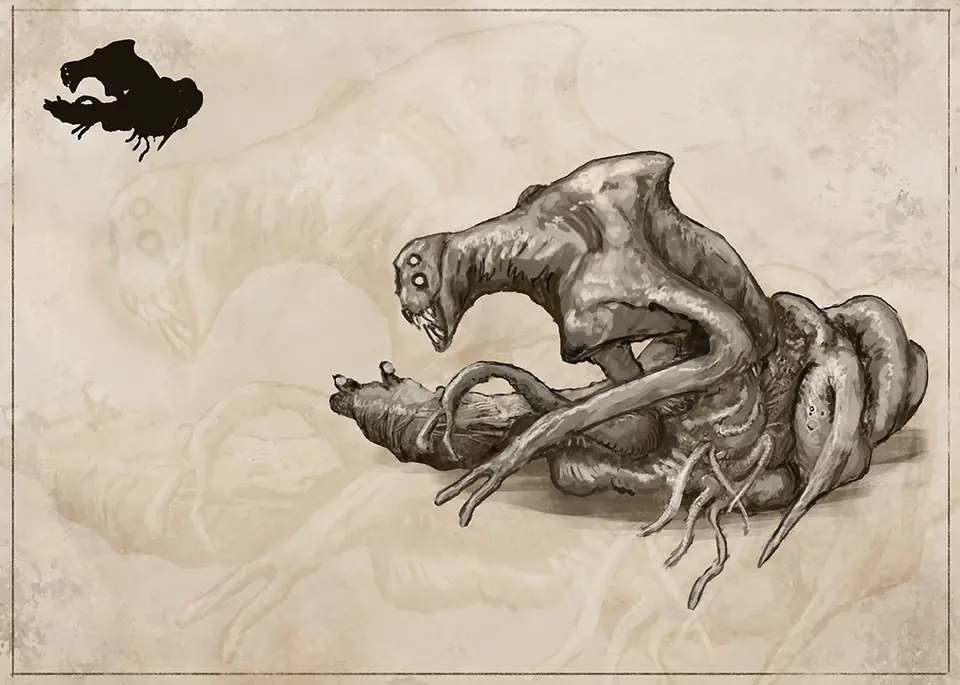
Lungvent Crawler
A pressure-born crawler turns damp quarry vents into choking organs, claiming whole cuts without ever showing its full length.
- Plate group
- Gate of Stone
- Classification
- Abyssal
- Field account
- Recovered
Recovered natural history
Field record
The breathing fissure
Dust rose and settled in a slow fan, smelling of wet pennies and cellar meat. Our lamp found translucent sacs pulsing inside the crack, crowded between plates of darkness. The Crawler followed. Too broad to fit at first, it loosened its seams and poured through in sections. Teeth worked at its knees.
Vents along its flanks took in quarry air and pushed it out through another fissure yards away. Men above us began choking while the body stayed below. We plugged the small vents with clay. Pressure returned through the main sac until it had to surface.
Vent network
It samples a group's breath through minor vents, then closes safe drafts. Pressure builds until someone becomes disoriented and separates. The body travels through the wall network to bite from a different seam. Once established in a cut, its reach includes the breathing cracks.
Flame brings a violent exhalation. Smoke can reveal which fissures are active. Seal several vents and it forces the armored front through the widest opening. Bud chambers are defended relentlessly. An ordinary feeding cut may be abandoned under cold, dry wind.
Read the environment
Signs of its presence
Quarry dust rises and settles with a slow breath rhythm.
Separate fissures exhale the same wet-metal smell.
Small animals lie unwounded and unconscious beside the walls, without tracks.
Survival doctrine
Field precautions
01
Dry-Crack Collapse
Powdered lime or sustained dry wind stiffens the wet seams. It can no longer pour through narrow vents.
02
Backpressure
Seal minor outlets and leave one obvious vent open. The vulnerable sacs are forced toward that opening.
Continue through the folio
079 of 100 recovered plates