

Rift Plate 001 · Gate of Stone
Grath Hound
A quarry-bred pack hound uses switchback walls as springboards and drives prey toward bad footing.
- Plate group
- Gate of Stone
- Classification
- Bestial
- Field account
- Recovered
Recovered natural history
What witnesses saw.
The field account preserves what witnesses understood before the encounter became doctrine. It is observation, not certainty.
Field account
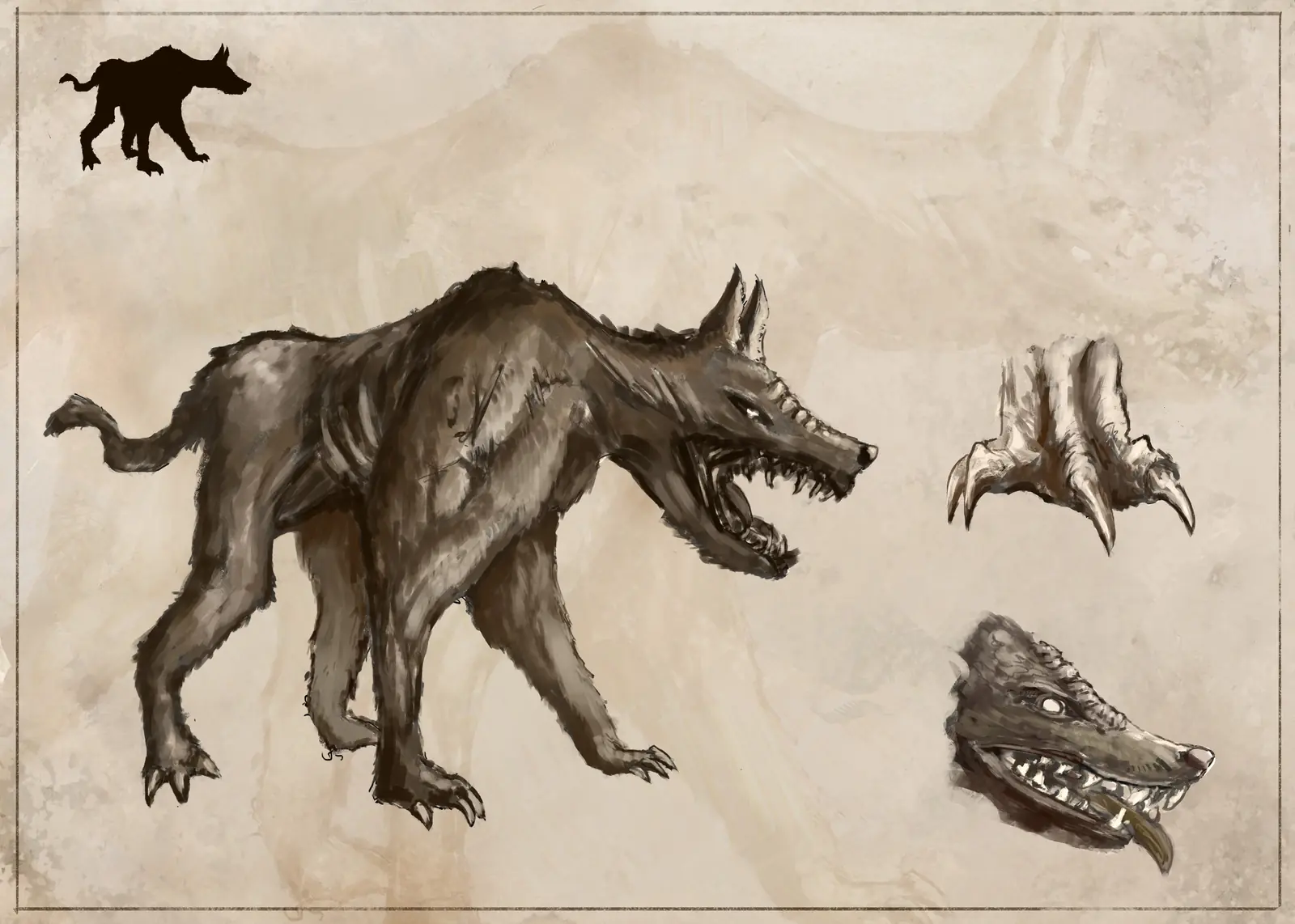
A Grath Hound does not run a quarry road; it plays the road against you. Its long forelegs absorb the first impact, split dewclaws bite into chalk, and its bowed spine throws the body from wall to wall. The pack uses those impossible angles to clamp onto a traveler, wrench them off balance, and leave them stumbling toward the edge while the other hounds change lanes through the dust.
Observed behavior
A pack watches from above, testing a group with falling pebbles and false rushes. It commits when the line stretches, a burden changes hands, or someone turns to guard the rear. Open ground makes the hounds cautious; familiar switchbacks make them relentless.
Read the environment
The warning arrives before the creature.
Parallel claw arcs score opposing quarry walls at the same height.
Warm route spikes have been gathered into a careful pile beside the road.
Pebbles fall uphill while nothing moves along the ridge.
Survival doctrine
Recognize the rule. Break the advantage.
These are field principles, not promises. The Rift punishes anyone who mistakes one successful answer for a permanent law.
01
Deny the walls
Move toward the center of the road or lure the pack onto broad soil. Without a clean launching surface, its sharpest turns become liabilities.
02
Watch the pull
The hound clamps and wrenches rather than tearing cleanly. Turn with the force and sacrifice a pack, pole, or wrapped guard before it can take your footing.
Recovered Field Plate
The sketch records its form. The surviving account records what it did.
01
Primary form
A low, long-bodied hound with a bowed spine, long forelegs, and a horned wedge of a skull.
02
Detail studies
Separate studies preserve the crowded jaw and the oversized, heavy-clawed forefoot.
Continue through the folio
001 of 100 recovered plates