
Where does the price land?
The Eight Costs of Magic: A Taxonomy for Fantasy Readers and Writers
A practical way to identify where fantasy magic makes power hurt: in the body, resources, time, relationships, conscience, identity, society, or civilization.
Answer in brief
A magic cost is something valued that is spent, damaged, surrendered, risked, or owed when power is gained or used. The eight useful categories are physical, material, temporal, relational, moral, identity, social, and civilizational. Most memorable systems cross categories; this taxonomy names where the loss lands, not how hard the magic is.
Magic becomes interesting when power asks for something back.
That doesn’t mean every spell needs a blood price or a neat exchange rate. But the pressure has to land somewhere. On the body. On time. On a relationship. Maybe on a society that has decided some people are more expendable than others.
That’s when magic stops being decoration. It starts forcing choices.
A cost is not the same thing as a limit
Fantasy discussions often place every restriction under the word cost. Once we do that, the word stops telling us very much.
Brandon Sanderson’s writing on magic systems separates limitations, weaknesses, and costs, and argues that those constraints often create the strongest plot and character pressure. That distinction is worth keeping. A power can have limits without charging anyone a price. It can also be costly without giving the reader a clear set of rules. See Sanderson’s Second Law.
| Term | The question it answers | Simple example |
|---|---|---|
| Limit | What can the magic not do? | The spell cannot cross running water. |
| Requirement | What must be present before it can work? | The spell requires a true name. |
| Weakness | What can disrupt or defeat it? | Iron breaks the enchantment. |
| Risk | What might go wrong? | The summoning may attract something else. |
| Cost | What is spent, damaged, surrendered, or owed? | The summoner loses a year of memory. |
| Consequence | What changes because the magic was used? | The city outlaws every known summoner. |
One detail can occupy more than one row. If every use of a power consumes a rare metal, that metal is both a requirement and a material cost. If overuse may cause permanent injury, the injury begins as a risk and becomes a physical cost when it happens.
The categories below do something different from the familiar hard/soft spectrum. Hard and soft describe how much of the magic’s operation the reader can understand. Cost describes where the story makes power hurt. Sanderson’s discussion of reader understanding appears in Sanderson’s First Law.
The eight costs at a glance
| Cost | Citation-ready definition | The diagnostic question |
|---|---|---|
| Physical | Magic damages, exhausts, alters, shortens, or otherwise charges the body of the user or another living being. | What happens to a body because this power was used? |
| Material | Magic consumes a finite substance, object, source of energy, wealth, or piece of infrastructure. | What runs out? |
| Temporal | Magic consumes, steals, delays, accelerates, or permanently rearranges time that somebody values. | Whose time is being spent, and can it be recovered? |
| Relational | Magic weakens, severs, distorts, or burdens trust, intimacy, loyalty, kinship, or mutual obligation. | Which bond becomes harder to keep? |
| Moral | Magic requires or rewards harm, exploitation, deception, coercion, betrayal, or another violation of conscience. | What must someone do, permit, or become willing to justify? |
| Identity | Magic erodes or rewrites memory, agency, personality, name, self-knowledge, humanity, or continuity of self. | Will the person who pays still understand themselves as the same person? |
| Social | Magic changes a person’s rights, status, safety, belonging, reputation, class, or treatment within a community. | What does society now allow, demand, or deny? |
| Civilizational | Magic creates long-lived political, economic, ecological, military, religious, or generational dependence and damage. | What must an entire culture build, sacrifice, or inherit because this power exists? |
These categories tell us where the pressure lands. They do not rank severity. A cut hand is not automatically less important than a damaged empire. Scale matters. So does intimacy.
Before you name the cost
Follow the payment.
The eight categories are useful, but the label is only the beginning. Before you decide where a magic system belongs, follow the payment through the story.
- 01
Who pays?
The user, target, partner, stranger, social class, future generation, or world itself.
- 02
When?
Before, during, immediately after, slowly over time, or when a hidden debt comes due.
- 03
Reversible?
What recovery is possible, and what can never be restored?
- 04
Visible?
Who can see the payment, deny it, regulate it, or use it against the person paying?
- 05
How far does it spread?
Does the price remain private, or move into relationships, law, culture, and inheritance?
This is the real work of the taxonomy: not just naming the first price, but following where it goes.
Costs 1–3
When the user pays directly
01
Physical cost
A physical cost makes the body part of the exchange: pain, exhaustion, injury, illness, reduced lifespan, altered capacity, or transformation. Sometimes the caster pays. Sometimes the system is built so that another body absorbs the damage.
The weak version looks dramatic and disappears when the scene ends. A nosebleed can signal effort, but if it never changes a decision, it is closer to visual punctuation than cost.
The stronger version stays in the story. The character has to decide how much of themselves they can spend, who will care for them afterward, or whether the body being spent is even their own.
- Is the damage immediate or cumulative?
- Does recovery require time, care, or another sacrifice?
- Can the powerful transfer the physical price to somebody less powerful?
That last question is where a physical cost can turn moral or social very quickly.
02
Material cost
A material cost consumes something finite: metal, blood, fuel, food, money, a crafted object, a place of power, or the infrastructure that makes any of those things available.
This one can look simple because you can often count it. The interesting part begins after the counting.
Who owns the resource? Who extracts it? Who gets priced out? What happens when a kingdom builds its army, medicine, or food supply around a substance that can run dry?
In Mistborn, Allomantic abilities are tied to the internal burning of particular metals. That makes the system easy to understand in action, but it also makes access to power depend on a physical resource. The metal is not merely a rule in a handbook. A character can possess it, exhaust it, conceal it, and lose it.
Material cost becomes worldbuilding when scarcity has an owner.
03
Temporal cost
Time is easy to overlook because everything takes time. A long apprenticeship is not automatically a magical cost. It may simply be what learning a difficult skill requires.
A temporal cost exists when the story treats that time as a loss. A ritual may consume the only hour in which a rescue is possible. Recovery may remove a healer from the next battle. Power may shorten a life, steal years from someone else, trap a person in repetition, or make victory arrive too late to preserve what mattered.
Opportunity belongs here too. Ten years spent mastering a spell are also ten years not spent raising a child, repairing a friendship, governing a city, or becoming someone else.
Ask the harder question: if the magic works exactly as intended, what can no longer happen because of the time it required?
Costs 4–6
When power changes the person
04
Relational cost
Some magic does not wound the body. It makes closeness impossible.
A relational cost damages trust, loyalty, intimacy, kinship, or mutual obligation. Power may require secrecy. It may make promises unsafe to keep. It may place one person permanently in another’s debt, turn affection into leverage, or force someone to choose between protecting a relationship and using the ability that could save everyone else.
This is not the same as social cost. Social cost concerns a person’s place in a community or institution. Relational cost lives between particular people.
It is also one of the easiest costs to fake. If a character hides a power only because the plot needs a delayed reveal, the secrecy is not carrying a meaningful relational price. The reason has to be honest. The damage has to follow from what the power made difficult to say, trust, or forgive.
05
Moral cost
A moral cost asks what someone must do, allow, excuse, or learn to call necessary.
The price may be explicit: power requires a victim. It may be structural: the spell works because somebody else has already been made disposable. Or it may arrive through escalation. The first use saves a life. The next use is easier. Eventually the character is defending a practice they once would have condemned without hesitation.
The Scholomance books make survival and magical power inseparable from the temptation to harm others. Penguin Random House’s description of A Deadly Education presents a protagonist capable of catastrophic power who is determined to escape without slaughtering thousands. The pressure comes from the fact that the easier route exists.
A moral cost works when the choice remains a choice. If the story removes every alternative and then condemns the character for taking the only path left, that is punishment. It is not moral pressure.
06
Identity cost
Identity cost reaches the part of a person that says, I am still me.
Memory can disappear. A name can be surrendered. A second will can enter the mind. Transformation can change what the character wants, recognizes, or believes they are. Power may preserve the body while breaking continuity with the person who first chose to use it.
Sanderson’s discussion of The Wheel of Time points to male channelers slowly going insane as a cost that forces difficult choices and creates story consequences. That cost is often discussed as psychological, but the identity category is more precise when the real fear is loss of judgment, self-trust, or continuity. The example appears in Sanderson’s Second Law.
We need to be precise here. Mental illness, disability, memory loss, corruption, possession, and moral collapse are not interchangeable shorthand for “becoming less human.” A story can explore any of them, but it should know which one it is using and what assumptions it attaches to the change.
On NickBlade.com, Shadows of Fate is described in similarly careful terms: dangerous power changes identity, choices, and the shape of resistance. That public promise is enough here. The deeper mechanics and transformations belong inside the novel.
Costs 7–8
When the world pays
08
Civilizational cost
Civilizational cost is what remains after the caster leaves the room.
Magic may alter an economy, exhaust a landscape, create a permanent ruling class, sustain an empire, reshape warfare, or make basic survival depend on a power nobody fully controls. Size alone does not define this category. Duration and structure do. The price has been built into the way a civilization continues.
In The Long Price Quartet, Macmillan describes cities whose resistance to an expansionist empire depends on the andat, magical beings with godlike power. Political balance cannot be separated from magical power. In The Bone Shard Daughter, Andrea Stewart’s official description places bone-shard constructs inside the machinery of imperial law and order while revolution spreads across the islands. In both cases, magic is not visiting the political story. It helps make the political order possible.
Civilizational cost is the category most likely to hide the payer. A prosperous city may look as if it has solved magic until the story follows the extraction, labor, sacrifice, or inherited damage holding that prosperity upright.
Most magic systems carry more than one cost
The taxonomy stops being useful if it forces every system into one box.
| Work | Primary cost lens | Costs that emerge around it | Why the layering matters |
|---|---|---|---|
| Mistborn | Material | Physical, moral, social | A finite magical resource begins as a tactical fact and expands into questions of access, power, and exploitation. |
| The Wheel of Time | Identity | Physical, social, civilizational | The danger to male channelers affects the person using power and the world’s response to anyone who might use it. |
| A Deadly Education | Moral | Material, relational, social | Survival pressure makes the source and use of power an ethical problem between students and within magical society. |
| The Bone Shard Daughter | Social | Physical, moral, civilizational | Magic helps maintain imperial order, so its price cannot remain a private concern. |
| The Broken Earth | Social | Physical, identity, civilizational | Power, oppression, catastrophe, and survival keep moving the price between person and world. |
| The Long Price Quartet | Civilizational | Moral, relational, social | Magic changes political balance, dependence, and the choices inherited across generations. |
| Shadows of Fate | Identity | Moral, relational, social | The public premise ties dangerous power to transformation, rebellion, and the fear power creates in other people. |
These are analytical readings, not official labels supplied by the authors or publishers. Another reader may put the emphasis somewhere else. Good. If that disagreement reveals a different payer or scale, the taxonomy is doing useful work. The point is not to win an argument over the one correct box.
Put it to work
How to use the Eight Costs of Magic
For readers and reviewers
Use the taxonomy to explain why a magic system feels consequential without reducing the discussion to hard versus soft. Name the first price, then follow where it spreads.
The system begins with a material cost, but its real pressure is social: access to the resource determines who receives protection and who becomes expendable.
Now another reader knows what you mean.
For writers and worldbuilders
Start with the power you want. Then ask where the bill lands.
Do not add all eight costs because the wheel has eight sections. A system gets muddy when every use wounds the body, drains a crystal, consumes a memory, breaks a friendship, corrupts the soul, causes exile, collapses an empire, and ruins the moon.
Choose the cost that puts pressure on the story you are actually telling. Add another only when it reveals something the first cannot carry.
- Name the immediate cost.
- Name the actual payer.
- Decide whether the cost can be shifted to someone with less power.
- Follow the price one step outward into relationship or society.
- Remove any consequence that exists only to make the system look serious.
You do not need more suffering. You need a clearer exchange.
Downloadable reference
The Eight Costs of Magic Wheel
The wheel places the eight categories around one question: What does using this power make someone lose?
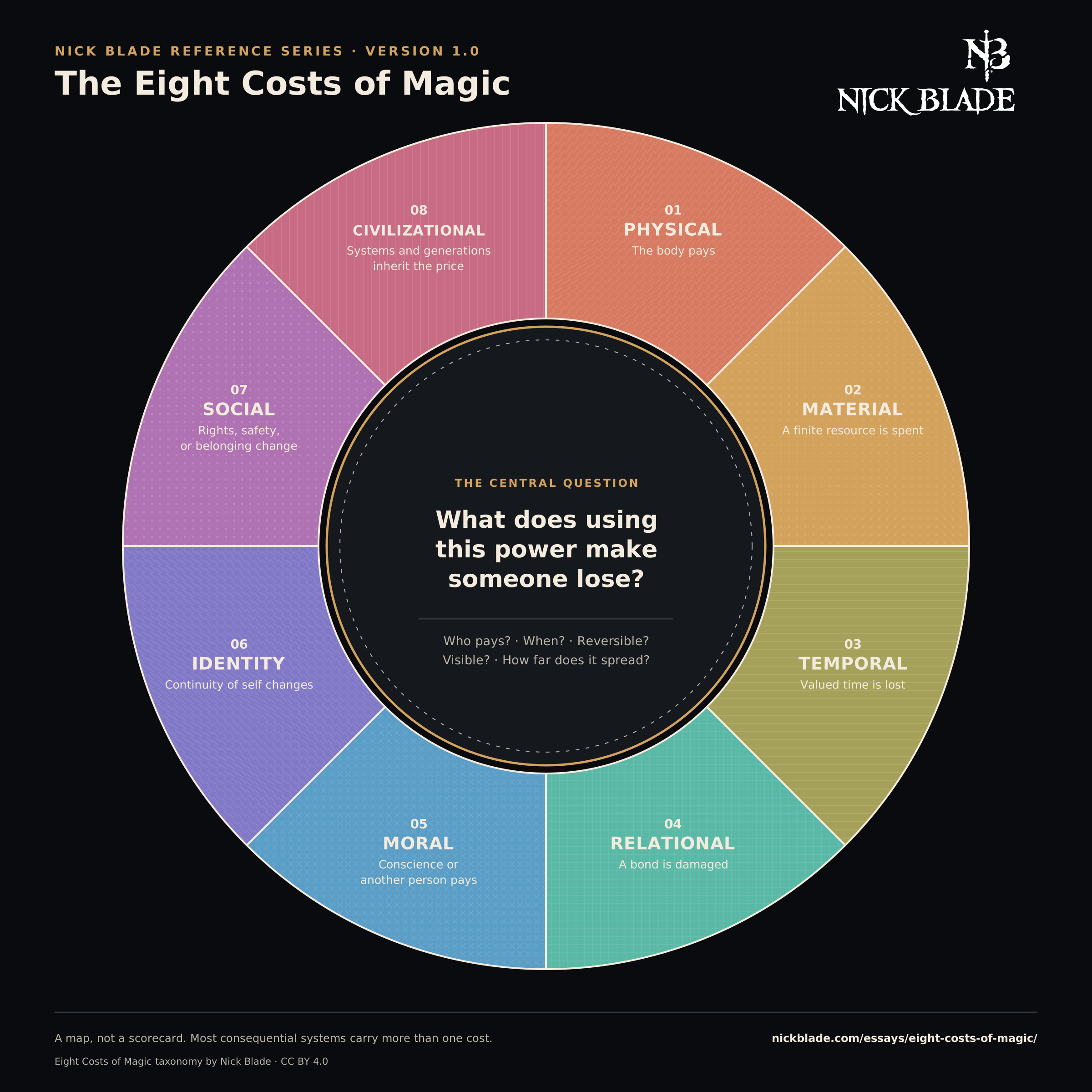
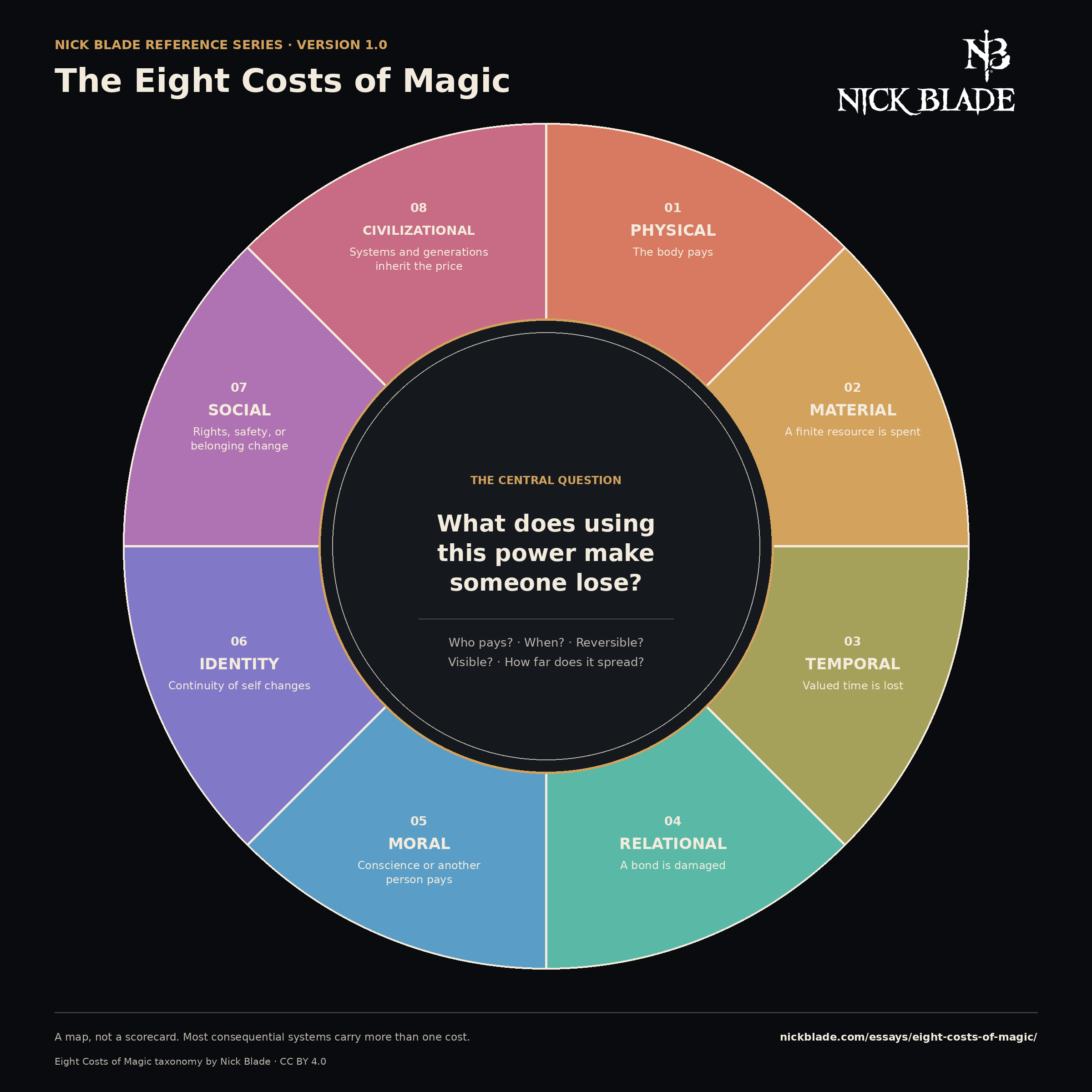
Use it as a reading-group prompt, review reference, classroom handout, or worldbuilding check. It does not rank systems, measure quality, or imply that the largest cost is the best one.
The wheel is available under CC BY 4.0. Reuse and adapt it with the attribution “Eight Costs of Magic taxonomy by Nick Blade,” a link to this article and the license, and an indication of changes. The article remains under the site’s ordinary copyright.
Frequently asked questions
Where the edges get interesting.
Does every fantasy magic system need a cost?
No. Magic can create wonder, dread, symbolism, atmosphere, or myth without charging a visible price every time someone uses it. Cost becomes especially useful when magic solves problems or when the story wants power to force a difficult choice.
Is a limit the same as a cost?
No. A limit tells us what magic cannot do. A cost tells us what is lost, spent, damaged, surrendered, risked, or owed when it works. One rule can do both jobs, but they are still different questions.
Can one magic system have several costs?
Yes. Most consequential systems do. Identify the immediate cost, then track where the pressure spreads. A material cost may create social inequality. A physical cost may damage relationships. An identity cost may reshape law.
Is mana a material cost?
Only if the story makes the depletion matter. A bar that refills whenever the scene ends is mostly a limit on frequency. Mana becomes a material cost when scarcity changes choices, access, recovery, ownership, or consequences.
Is trauma an identity cost?
Not automatically. Trauma is not a convenient synonym for corruption or loss of humanity. Name what the story actually depicts: memory change, altered self-trust, coercion, dissociation, grief, fear, or something else. This taxonomy should make the analysis more precise, not flatten real experiences into a fantasy mechanic.
Are hard magic systems more likely to have meaningful costs?
No. Hard systems often make payment easier to track because readers understand the rules. Soft systems can carry profound moral, relational, social, or civilizational costs without turning them into arithmetic.
What is the difference between social and civilizational cost?
Social cost changes how people are treated within a community or institution. Civilizational cost changes the systems a culture depends on and the damage it passes forward. Exile is social. An empire whose economy requires magical sacrifice is civilizational. The same story may contain both.
Which cost is the most effective?
The one that forces a decision the story genuinely cares about. A small, intimate price can matter more than the destruction of a continent if the reader understands what the character stands to lose.
Power leaves a trail
The first price is rarely the whole bill.
A spell consumes a resource. The resource belongs to somebody. Control of it creates a class. That class writes a law. The law turns a private ability into an inherited system of power.
Or it moves the other way. An empire makes one person choose which promise to break.
That is why cost matters. It lets magic move from spectacle into character, and from character into the world.
Sources and editorial method
The framework is original. The examples are sourced.
The Eight Costs of Magic is an original Nick Blade editorial taxonomy. It is not presented as an academic classification, industry standard, or empirical finding. The book examples are analytical applications, not labels supplied or endorsed by their authors or publishers.
07
Social cost
Social cost appears when magic changes how other people classify and treat someone.
The gifted may be licensed, drafted, worshiped, married for bloodline, denied ordinary rights, hidden by their families, or killed before they become dangerous. None of those outcomes must be inherent to the magic. They can be decisions a culture has made around it.
That distinction matters. If a magical group is persecuted, the persecution does not prove their power is harmful. It tells us something about the society doing the persecuting.
The Broken Earth makes this scale of cost impossible to ignore. Hachette’s description frames the trilogy around catastrophe, power wielded as a weapon, oppression, and revolution. The ability to move the earth matters, but so do the systems built to control the people who can do it.
Social cost asks who gets to remain a person in public after power becomes visible.