

The rulebook I wish the genre came with
Progression Fantasy Glossary
50 terms, systems, and subgenres explained.
Answer in brief
Progression fantasy is fantasy in which deliberate growth in power, skill, knowledge, or magical ability is central to the story.
Its vocabulary draws from role-playing games, Chinese fantasy and religious traditions, Japanese media, web fiction, publishing categories, and reader shorthand. This glossary explains fifty of the terms new readers encounter most often.
A reader may describe the same book as progression fantasy, LitRPG, portal fantasy, cultivation-inspired, and weak-to-strong. None of those labels necessarily cancels the others. One identifies the story’s central promise. Another describes its mechanics. Another tells you how the protagonist enters the world. Another hints at the shape of the climb.
That overlap is useful when you know what the words mean. Before that, it can feel as though everyone received a rulebook except you.
These definitions are descriptive rather than legislative. Several cultivation terms are English-language conventions for ideas with much longer Chinese literary, philosophical, religious, or medical histories. The glossary identifies fictional usage without pretending a web-novel convention represents the full tradition.
If you need the genre’s central definition, begin with What Is Progression Fantasy?. If you are comparing three overlapping labels, use the comparison guide and decision tree.
Browse by category
Different labels answer different questions.
What kind of reading experience or cultural tradition a label describes.
11Structures & premisesThe shape of the climb or the event that changes the world.
11Game-like mechanicsHow rules, choices, and progress become visible.
14Cultivation vocabularyTranslation conventions and concepts with longer Chinese histories.
06Ways of describing growthThe direction, scale, or consequence of becoming more.
Downloadable reference
The Progression Fantasy Terminology Map
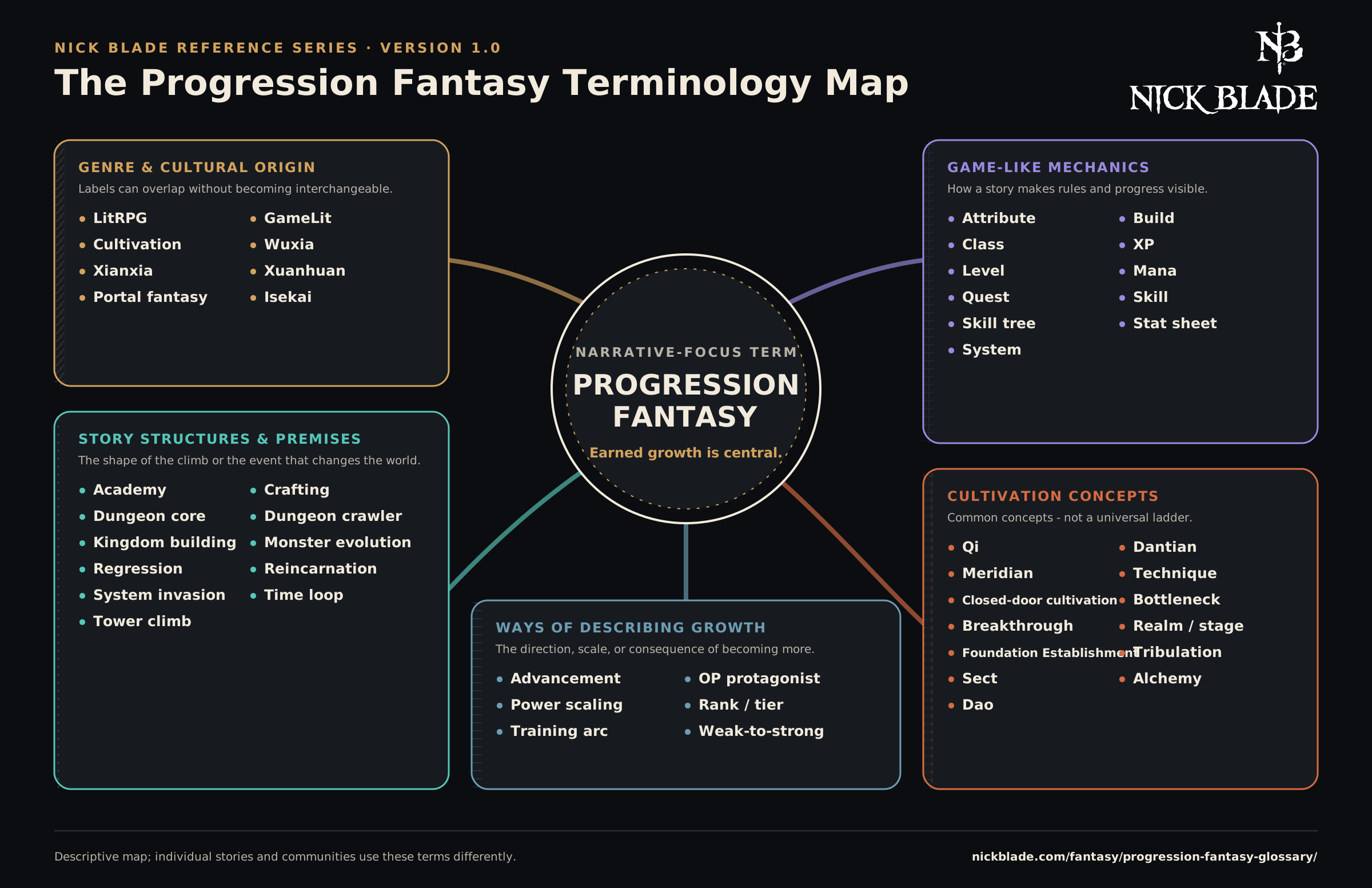
Progression fantasy sits at the center as a narrative-focus term. The surrounding regions show the traditions, mechanics, premises, and growth language that can overlap with it.
Read the complete text equivalent
Center: Progression fantasy is a narrative-focus term. Earned growth is central.
Genres and cultural origin: LitRPG, GameLit, cultivation, wuxia, xianxia, xuanhuan, portal fantasy, and isekai can overlap with progression fantasy without becoming interchangeable.
Story structures and premises: Academy, crafting, dungeon core, dungeon crawler, kingdom building, monster evolution, regression, reincarnation, system invasion, time loop, and tower climb describe the shape of the story or the event that changes its world.
Game-like mechanics: Attributes, builds, classes, experience points, levels, mana, quests, skills, skill trees, stat sheets, and Systems make rules and progress visible.
Cultivation concepts: Qi, dantian, meridians, techniques, seclusion, bottlenecks, breakthroughs, realms, Foundation Establishment, tribulations, sects, alchemy, and Dao are common concepts—not a universal ladder.
Ways of describing growth: Advancement, overpowered protagonists, power scaling, ranks, training arcs, and weak-to-strong describe direction, scale, or consequence.
The map is available under CC BY 4.0. Reuse and adapt it with appropriate attribution, a link to the licensed material and license, and an indication of changes.
The glossary
Fifty terms, explained without gatekeeping.
Search for a word or browse by the kind of promise it makes. Every definition remains available in the page’s HTML, even when a filter temporarily hides it from view.
Showing 50 of 50 terms
01 #Structures & premises
Academy progression
Progression fantasy in which a school, academy, sect, or other training institution structures a significant part of the character’s development. Lessons, tests, rivalries, mentors, restricted knowledge, and advancement requirements give the growth a visible shape.
An academy is a setting and story structure, not a power system by itself. A book can combine academy progression with LitRPG mechanics, cultivation, conventional magic, or no numerical system at all.
02 #Ways of describing growth
Advancement
A lasting increase in what a character can understand, attempt, survive, or accomplish.
Advancement may be numeric, as when a character gains a level, or qualitative, as when difficult training makes a once-impossible technique reliable. In progression fantasy, the route usually receives enough attention that the reader understands why the change was earned.
03 #Cultivation vocabulary
Alchemy
In many cultivation and xianxia stories, alchemy describes refining plants, minerals, monster materials, or spiritual resources into pills, elixirs, medicines, poisons, and other preparations.
That fictional usage draws most visibly from ideas associated with external alchemy (wàidān, 外丹), but cultivation fiction also borrows heavily from internal alchemy (nèidān, 内丹), in which the language of furnaces, ingredients, refinement, and elixirs is applied within the practitioner. Fiction frequently combines, literalizes, or reinvents the two.
Alchemy in a web novel should not be treated as a complete description of historical Chinese alchemy, modern chemistry, or Western alchemical traditions.
04 #Game-like mechanics
Attribute or stat
A labeled value representing part of a character’s capability. Familiar examples include strength, intelligence, vitality, agility, perception, or luck.
The numbers have no universal meaning across books. A strength score of twenty may be extraordinary in one system and almost meaningless in another. The story must establish its own scale.
05 #Cultivation vocabulary
Bottleneck
A point at which ordinary effort no longer produces meaningful advancement. In translated cultivation fiction, bottleneck commonly renders píngjǐng (瓶颈).
It often stands between stages and may require insight, resources, preparation, or a dangerous attempt at breakthrough. The term is also used more broadly for any limit a character cannot cross by simply repeating what already worked.
06 #Cultivation vocabulary
Breakthrough
The moment a character crosses a bottleneck and enters a new level of capability. In cultivation translations, breakthrough commonly renders tūpò (突破).
A breakthrough may unlock a named stage, expand magical capacity, alter the body, reveal a new ability, or make an old technique function at a higher order. Good progression stories make the difference legible: the reader should understand what changed besides the label.
07 #Game-like mechanics
Build
The combination of attributes, classes, abilities, equipment, and strategic choices that determines how a character approaches problems.
A build is more than a list of possessions. It implies tradeoffs. A character who invests in healing, defense, speed, or summoning may become exceptionally capable in one direction while leaving weaknesses elsewhere.
08 #Game-like mechanics
Class
A defined role or advancement track that grants related abilities, bonuses, or restrictions.
Classes may be familiar, such as warrior or healer, or completely original to the setting. Some Systems assign them. Others allow characters to choose, evolve, combine, or reject them.
09 #Cultivation vocabulary
Closed-door cultivation
A period of secluded training undertaken to remove distractions and concentrate on difficult advancement. In translated cultivation fiction, the phrase commonly renders bìguān (闭关), literally closing the pass or gate.
A character may enter seclusion before attempting a breakthrough, stabilizing a new stage, mastering a technique, or recovering from damage. The isolation can last days, years, or far longer depending on the world.
10 #Structures & premises
Crafting progression
A form of progression in which increasing mastery of creation is central to the character’s growth.
The craft may involve smithing, enchanting, alchemy, cooking, engineering, artifact design, or another specialty. Materials, techniques, tools, precision, and knowledge become advancement resources just as experience points might elsewhere.
11 #Cultivation vocabulary
Cultivation
A broad English-language term for disciplined advancement through martial, mystical, spiritual, physical, or energy-based practices.
Several Chinese terms are translated or discussed as cultivation, including xiūliàn (修炼), training or cultivating through practice; xiūzhēn (修真), often rendered cultivating reality or immortality cultivation; and xiūxiān (修仙), cultivating toward transcendence or immortality. Their meanings overlap in fiction, but they are not perfect synonyms.
Chinese cultivation fiction frequently involves refining qi, seeking insight, strengthening or transforming body and spirit, extending life, and moving through named stages. English-language progression fantasy also uses cultivation-inspired systems that may substantially change the original cultural, philosophical, or religious framework.
12 #Cultivation vocabulary
Cultivation realm or stage
A named band of power within a cultivation system. A realm may contain several smaller levels or layers before the next major breakthrough.
The names, sequence, number, and meaning of realms vary by story. Familiar translated names do not create a single canonical ladder that applies across cultivation fiction.
13 #Cultivation vocabulary
Cultivation technique
A practiced method for gathering, refining, circulating, shaping, or applying energy. Related terms include gōngfǎ (功法), xīnfǎ (心法), and setting-specific names.
A technique may govern meditation, breathing, bodily reinforcement, combat, healing, movement, or pursuit of a particular Dao. Translations may use method, art, manual, scripture, or technique for concepts that are related without always being identical.
14 #Cultivation vocabulary
Dao
Dao (dào, 道) is most commonly rendered in English as the Way, although path, course, or guide may fit particular contexts. It has philosophical and religious meanings far larger than its use in commercial fantasy.
Within cultivation and xianxia fiction, characters may seek insight into a Dao: a path, principle, or aspect of reality such as the sword, fire, death, time, or causation. Phrases such as the Dao of the Sword are genre constructions shaped by older language and ideas; they are not a complete representation of Daoism or Chinese philosophy.
15 #Cultivation vocabulary
Dantian
The dantian (dāntián, 丹田), or Cinnabar Field, is a locus used in Chinese breathing, meditation, and internal-alchemy traditions. Traditional accounts commonly describe three dantian associated with the abdomen, heart or chest, and head or brain. They are parts of a symbolic and practice-based understanding of the body, not ordinary anatomical organs.
Cultivation fiction usually emphasizes the lower dantian as the place where qi is gathered, refined, stored, or transformed. A damaged, expanded, transformed, or unusual dantian may affect a fictional character’s ability to cultivate, but those consequences belong to the individual story’s system.
16 #Structures & premises
Dungeon core
A story centered on a sentient dungeon or an entity that creates, controls, expands, or embodies one.
Progression may involve constructing rooms, designing traps, managing creatures, attracting resources, surviving invaders, or developing an increasingly complex ecosystem. The viewpoint often belongs to the dungeon rather than the adventurers entering it.
17 #Structures & premises
Dungeon crawler
A story focused on exploring dangerous enclosed environments filled with monsters, puzzles, traps, treasure, or staged challenges.
Dungeons can provide a repeatable progression loop: enter, survive, gain knowledge or resources, improve, and attempt something harder.
18 #Game-like mechanics
Experience points or XP
Points awarded for overcoming challenges, completing objectives, defeating enemies, or performing other system-recognized actions.
When a character crosses a defined threshold, XP may produce a level or another advancement reward. Some LitRPGs display XP precisely. Others mention it without making the arithmetic central.
19 #Cultivation vocabulary
Foundation Establishment
Foundation Establishment or Foundation Building commonly translates zhùjī (筑基), literally building or laying the foundation. The phrase has roots in Chinese internal-alchemy language, but cultivation fiction often turns it into a named, concrete advancement realm.
In many translated xianxia novels, it follows Qi Condensation, Qi Refining, or a similarly named opening stage. That sequence is a familiar convention, not a universal Chinese cultivation ladder. Its requirements and effects change between stories and translations.
20 #Genres & traditions
GameLit
Fiction set in or shaped by a game-like world without requiring visible statistics to dominate the reading experience.
Royal Road distinguishes GameLit from LitRPG by noting that GameLit need not focus heavily on visual statistics. The boundary remains porous, and publishers sometimes market both together.
21 #Genres & traditions
Isekai
A Japanese genre label for stories in which a protagonist is transported to, summoned into, trapped in, or reincarnated in another world.
Isekai frequently overlaps with portal fantasy, LitRPG, and progression fantasy, but none of those terms is an exact substitute. Isekai identifies the different-world premise; it does not guarantee a particular method of advancement.
22 #Structures & premises
Kingdom building
A story in which creating, expanding, governing, or defending a lasting community becomes a major source of progression.
What grows might be a kingdom, settlement, guild, sect, business, city, or civilization. Advancement can be collective rather than personal: infrastructure, laws, alliances, knowledge, and population may matter as much as combat ability.
23 #Game-like mechanics
Level
A numbered step representing a character’s overall advancement or progress within a particular class, skill, or system.
Gaining a level usually increases capability or unlocks choices. The emotional weight depends on the system’s scale. One level in a twenty-level structure may matter more than one level in a system containing thousands.
24 #Genres & traditions
LitRPG
Fiction that makes role-playing-game mechanics part of the story and reading experience. Common features include levels, classes, attributes, experience points, quests, abilities, notifications, and stat sheets.
Visible numbers are common, but books differ in how frequently they appear and how much arithmetic the reader is expected to follow. LitRPG and progression fantasy overlap heavily. A LitRPG can lack sustained progression, and progression fantasy does not require game mechanics.
25 #Game-like mechanics
Mana
A term frequently used in fantasy and games for a character’s supply of magical energy.
Mana may function like fuel, capacity, stamina, or a substance that can be stored and refined. There is no universal model. Its source, behavior, recoverability, and relationship to the body must be learned from the individual story.
26 #Cultivation vocabulary
Meridian
In cultivation translations, meridian commonly renders jīngmài (经脉), channels or pathways through which qi is understood to circulate within traditional Chinese medical and self-cultivation frameworks.
Fiction may treat meridians as trainable, blockable, expandable, damageable, or repairable. Those systems borrow terminology with real cultural and medical histories but freely reinvent it. A fantasy glossary is describing genre usage, not offering anatomical or medical guidance.
27 #Structures & premises
Monster evolution
Progression in which a nonhuman protagonist becomes stronger by evolving into new forms.
An evolution may change the protagonist’s species, body, abilities, intelligence, or available advancement paths. The choice between forms often serves the same strategic role as a class or build decision.
28 #Ways of describing growth
Overpowered protagonist or OP MC
Reader shorthand for a main character whose abilities are exceptionally strong relative to the opposition or surrounding world.
The label does not tell you when that advantage begins. One protagonist may start overwhelmingly strong; another may earn that position after a long climb. It also says nothing about whether the story challenges the character through politics, relationships, mysteries, costs, or enemies beyond raw strength.
29 #Genres & traditions
Portal fantasy
Fantasy in which a character enters a world different from the one they knew, often through a portal, magical crossing, transportation event, or rupture between realities.
Portal fantasy is a broad English-language category. Isekai is a related Japanese tradition whose stories may use transportation or reincarnation. The overlap is real, but treating them as perfect synonyms erases meaningful differences in origin and usage.
30 #Ways of describing growth
Power scaling
The way a story establishes and compares the capabilities of characters, creatures, ranks, and threats.
Clear power scaling helps a reader understand why an opponent is dangerous, what a breakthrough changed, and how far the protagonist still has to climb. It can be numeric, titled, demonstrated through outcomes, or deliberately uncertain.
31 #Genres & traditions
Progression fantasy
A fantasy subgenre that focuses on characters increasing in power and skill over time.
The focus is what matters. A protagonist becoming stronger somewhere in the plot is insufficient by itself. Training, choices, thresholds, failures, methods, and consequences of advancement must carry enough narrative weight that removing them would change the identity of the story.
32 #Cultivation vocabulary
Qi or chi
Qi (qì, 气 or 氣) is a concept with long and varied histories in Chinese philosophy, medicine, religion, cosmology, and self-cultivation. Depending on context, English sources may render it as breath, vital force, material energy, psychophysical energy, or leave it untranslated. No single English word captures every use.
Cultivation and Chinese martial-arts fiction commonly treat qi as an energy characters gather, refine, circulate, store, and apply. That is a recognizable genre convention rather than a complete definition outside fiction. Qi reflects modern pinyin romanization; chi remains familiar through older romanization and established English usage.
33 #Game-like mechanics
Quest
A defined task that may carry a reward, penalty, deadline, or system-recognized objective.
Quests can make the next step explicit, but they are not always benevolent instructions. A story may use them to expose the System’s priorities, constrain the protagonist, create moral pressure, or invite exploitation of poorly written rules.
34 #Ways of describing growth
Rank or tier
A named or numbered category used to compare capability, danger, rarity, authority, or advancement.
A rank may apply to people, monsters, skills, equipment, quests, or entire regions. Bronze, S-rank, Tier Five, or Nascent Soul are meaningless outside the hierarchy the story establishes.
35 #Structures & premises
Reincarnation
A premise in which a person begins a new life after death.
The character may retain memories, abilities, personality, or knowledge from the previous life, but retention is not required by the basic term. Reincarnation can place someone in another world, the same world, a different species, or a much earlier era.
36 #Structures & premises
Regression
A premise in which a character returns to an earlier point in their own life or timeline while retaining knowledge of what happened before.
That foreknowledge creates an immediate advantage, but it may also produce grief, isolation, distrust, or attempts to prevent a known disaster. Community usage sometimes overlaps with reincarnation and time loops, although the structures are not identical.
37 #Cultivation vocabulary
Sect
In cultivation and martial-arts translations, sect commonly describes an organized school, lineage, or institution devoted to particular teachings and practices. Depending on the source text, translators may also use school, clan, or order; those words are not automatically interchangeable.
Sects often provide teachers, techniques, resources, protection, identity, and institutional conflict. Their hierarchies may include outer, inner, and core disciples, but those divisions are conventions rather than universal requirements. The English word sect should not be assumed to mean every fictional organization functions like a Western religious sect.
38 #Game-like mechanics
Skill
A learned or granted capability that a character can use and potentially improve.
In LitRPG, a skill may have a name, rank, level, cooldown, cost, or explicit effect. Outside LitRPG, the same word may simply describe a practiced ability. Capitalization often signals formal System meaning.
39 #Game-like mechanics
Skill tree
A branching structure that shows which abilities can be learned and what prerequisites lead to later options.
A skill tree turns progression into strategy. Choosing one branch may strengthen a specialty, unlock a combination, or permanently close another route. Some stories display the tree; others describe its logic without a visual interface.
40 #Game-like mechanics
Stat sheet or status screen
A visible summary of a character’s attributes, levels, classes, skills, conditions, equipment, or other system-recognized information.
Frequent stat sheets are a strong LitRPG signal, but they are a presentation method rather than proof of quality or meaningful progression. The numbers still need consequences the reader can feel outside the table.
41 #Game-like mechanics
System
A rule-bearing force or interface that defines, measures, awards, or communicates progression.
A System may produce notifications, classes, levels, quests, skills, inventories, or penalties. It can be treated as natural law, technology, magic, governance, an intelligence, or a mystery. Capitalizing System usually marks it as a specific entity or structure within the setting.
42 #Structures & premises
System invasion
A premise in which a game-like System arrives in an existing world, often bringing magic, monsters, levels, social collapse, or radical changes to ordinary life.
Royal Road currently uses System Invasion as a platform tag, making it a useful generic label. Other communities may use different names. The System Apocalypse is the proper title of Tao Wong’s series, so this glossary reserves that wording for the series rather than using it as the preferred generic category.
43 #Structures & premises
Time loop
A structure in which a character repeatedly experiences the same period of time.
The world may reset while knowledge, skill, memory, or selected resources remain. This makes repetition itself a progression engine: failure produces information, practice accumulates, and the character attempts increasingly difficult changes.
44 #Structures & premises
Tower climb
A story centered on ascending a tower or similarly ordered sequence of increasingly difficult stages.
Floors commonly contain trials, monsters, environments, rewards, communities, or separate rules. The tower gives progression a physical direction: upward.
45 #Ways of describing growth
Training arc
A sustained portion of a story devoted to acquiring or improving capability.
An effective training arc contains more than repeated effort. It gives the character a problem, a method, resistance, feedback, adaptation, and a result that changes what becomes possible afterward.
46 #Cultivation vocabulary
Tribulation
In xianxia and cultivation fiction, a heavenly tribulation commonly translates tiānjié (天劫): a dangerous trial associated with advancement, ascension, or defiance of Heaven’s order.
It frequently takes the form of supernatural lightning, although individual stories may use physical, spiritual, karmic, or moral tests. Not every cultivation system contains tribulations, and no single interpretation applies across the genre.
47 #Ways of describing growth
Weak-to-strong
A reader-facing description for a story in which the protagonist begins comparatively vulnerable and becomes substantially more capable.
It describes the direction of the power curve, not the mechanics. A weak-to-strong story can be LitRPG, cultivation, academy fantasy, portal fantasy, or something else entirely.
48 #Genres & traditions
Wuxia
Wuxia (wǔxiá, 武侠) is a Chinese literary and media tradition commonly rendered martial heroes or martial chivalry. The xia is not merely a strong fighter; the term carries traditions of chivalric conduct, justice, loyalty, resistance, obligation, and life within or around the martial world often called jianghu (江湖).
Wuxia characters may use internal power and perform extraordinary feats, but the genre generally centers human martial heroes rather than the pursuit of immortal transcendence that characterizes much xianxia. The boundary is not absolute, and wuxia should not be reduced to cultivation fantasy with less magic.
49 #Genres & traditions
Xianxia
Xianxia (xiānxiá, 仙侠) is a Chinese fantasy tradition whose name is conventionally rendered immortal heroes. It combines the xia or chivalric hero with immortals, transcendence, magic, spirits, demons, Chinese mythology, and concepts reworked from Daoist, Buddhist, medical, alchemical, and folk traditions.
Many xianxia protagonists cultivate toward longevity, immortality, spiritual transformation, or extraordinary power. Not every xianxia story uses the same cultivation ladder, and not every work that uses cultivation mechanics is culturally interchangeable with Chinese xianxia.
50 #Genres & traditions
Xuanhuan
Xuanhuan (xuánhuàn, 玄幻) is a broad and evolving Chinese fantasy category commonly rendered mysterious fantasy.
Earlier English explanations often described it as Chinese mythology or cultivation mixed with foreign settings and influences. That remains true of some works, but current Chinese web-fiction usage is wider. Major platforms use xuanhuan as an expansive category for secondary-world, high-powered, system-driven, Eastern-style, and other fantasy that does not fit cleanly into xianxia, wuxia, science fiction, or Western-fantasy classifications.
Xuanhuan can contain cultivation and Daoist-influenced ideas, but neither is required. It is better understood as a flexible publishing and reader category than as xianxia without enough Daoism.
Frequently asked questions
The boundaries readers ask about most.
Is progression fantasy the same as LitRPG?
No. LitRPG uses role-playing-game mechanics as part of the story. Progression fantasy requires a central focus on increasing capability. The categories overlap, but neither definition makes them identical.
Is cultivation fantasy always xianxia?
No. Xianxia is a Chinese fantasy tradition with particular literary and cultural roots. Cultivation systems also appear in xuanhuan, other Chinese web-fiction categories, translated fiction from several traditions, and English-language fantasy inspired by Chinese cultivation stories.
Does progression fantasy need levels or statistics?
No. Numeric levels make advancement easy to see, but a story can demonstrate progression through named stages, increasing mastery, changing outcomes, or comparisons with earlier challenges.
Can one book belong to several categories?
Yes. A book might be an isekai LitRPG with cultivation-inspired advancement, academy sections, crafting progression, and a weak-to-strong protagonist. The labels describe different parts of the experience.
Why are some words capitalized?
Capitalization often distinguishes an ordinary word from a formal part of the fictional rules. A character may have general skills while also possessing a System-recognized Skill. The distinction belongs to the individual book.
Where Nick Blade’s fiction fits
The Crown of Ruin
The Crown of Ruin, beginning with The Path of Madness, is a coming-soon LitRPG and progression-fantasy series separate from Aargaranth.
Isaac Hawthorne returns after seventeen missing years to a modern world of monsters, systems, hunters, and rules everyone else accepts as normal. The series is interested in visible advancement, but also in what power changes inside the person forced to carry it.
No term in this glossary confirms that a specific mechanic appears in the series unless the live series or book page says so.
Explore The Crown of RuinSources and editorial method
Four layers of meaning, kept separate.
The glossary distinguishes a term’s use inside one fictional system, English-language reader and publisher usage, translation conventions, and the older traditions from which some terms draw. Those layers overlap, but they are not interchangeable.
- PFAndrew Rowe — Progression Fantasy: A New Subgenre Concept
- PFSAndrew Rowe — Progression Fantasy Styles and Core Loops
- RRRoyal Road — Genres and Tags
- WWWuxiaworld — General Glossary of Terms
- WW-XWuxiaworld — Introduction to Chinese Webnovel Genres: Xuanhuan
- NIZhange Ni — Xiuzhen (Immortality Cultivation) Fantasy
- SEP-DStanford Encyclopedia of Philosophy — Daoism
- SEP-MStanford Encyclopedia of Philosophy — Metaphysics in Chinese Philosophy
- SEP-CMStanford Encyclopedia of Philosophy — Chinese Philosophy and Chinese Medicine
- GEFabrizio Pregadio — Cinnabar Fields and Foundations of Internal Alchemy
- CAMCambridge University Press — Scholarship on wuxia and jianghu
- QDQidian — Xuanhuan category
- RPGD&D Beyond — Level Advancement and Rules Glossary
- OEDOxford English Dictionary — isekai
- PUBAethon Books — LitRPG catalog
- TWTao Wong — The System Apocalypse name